Add SICP JS solutions #2
Closed
Conversation
This file contains hidden or bidirectional Unicode text that may be interpreted or compiled differently than what appears below. To review, open the file in an editor that reveals hidden Unicode characters.
Learn more about bidirectional Unicode characters


 arsalan0c
changed the title
arsalan0c
changed the title
 arsalan0c
force-pushed
the
non-det-examples
branch
from
arsalan0c
force-pushed
the
non-det-examples
branch
from
31c4419 to
850b67b
Compare

anubh-v
reviewed
Apr 14, 2020
| require(num_queens <= board_size); | ||
| const possible_positions = enum_list(1, board_size); | ||
|
|
||
| const result = accumulate( |
Collaborator

There was a problem hiding this comment.
Is there a reason to use accumulate, other than the fact that we want to perform the process num_queens times?
If not, can \ should we use for_each ?
Owner
Author
There was a problem hiding this comment.
Yes, accumulate gives us the positions that we have already, with the variable so_far. It is used in checking whether potential new rows and columns can be added.
arsalan0c
force-pushed
the
non-det-examples
branch
from
09edcc3 to
726cf39
Compare
anubh-v
reviewed
Apr 14, 2020
arsalan0c
changed the title
Owner
Author

Sign up for free
to join this conversation on GitHub.
Already have an account?
Sign in to comment


Add this suggestion to a batch that can be applied as a single commit.
This suggestion is invalid because no changes were made to the code.
Suggestions cannot be applied while the pull request is closed.
Suggestions cannot be applied while viewing a subset of changes.
Only one suggestion per line can be applied in a batch.
Add this suggestion to a batch that can be applied as a single commit.
Applying suggestions on deleted lines is not supported.
You must change the existing code in this line in order to create a valid suggestion.
Outdated suggestions cannot be applied.
This suggestion has been applied or marked resolved.
Suggestions cannot be applied from pending reviews.
Suggestions cannot be applied on multi-line comments.
Suggestions cannot be applied while the pull request is queued to merge.
Suggestion cannot be applied right now. Please check back later.
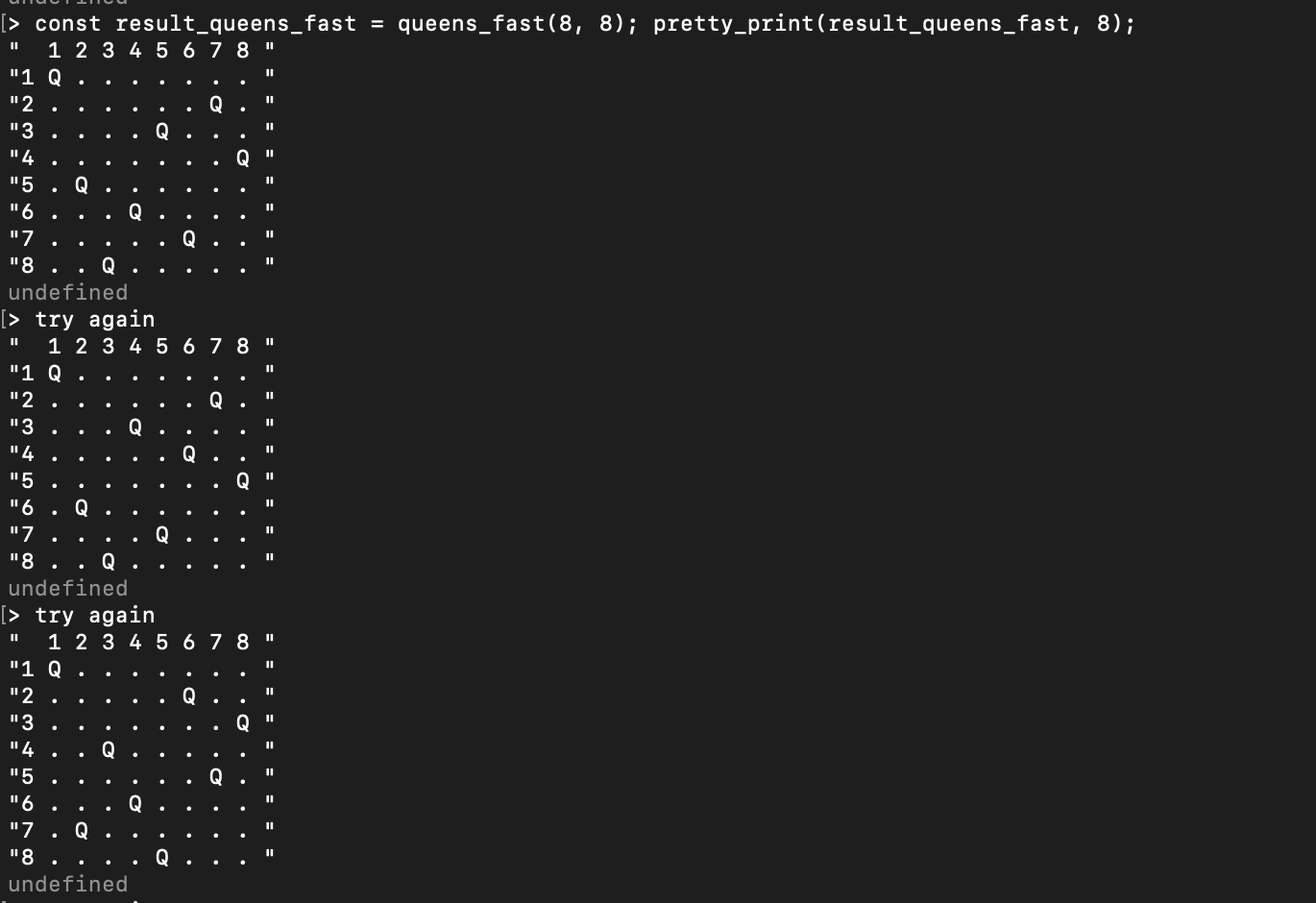
This PR adds two solutions for the n-queens puzzle using the Source 3 non-deterministic language. Each of them makes use of the generate-and-test paradigm.
The first (
queens_slow) uses non-determinism for generating both the row and column for each position. It does so in an optimized manner, testing the corresponding condition as soon as the choice is generated, thereby reducing the search space. However, this is not enough to yield a quick solution when N = 8. This solution also gives repeated solutions (i.e different permutations that have all the same positions) upon backtracking.The second (
queens_fast) uses non-determinism in picking only the row and not the column of each position, with the columns being fixed. This further reduces the search space, yielding a quick solution when N = 8.Example: