Correct computation of SPI baud rate register value, and allow for the value to be 0. #560
Conversation


|
I thought of something better overnight, which is to accept any frequency and just give the nearest one. So it would never throw an exception for a bad frequency. Then I will also add an attribute to return the actual frequency. If you like that, hold off on the merge and I'll push something new. |

|
Yes, I think that would be the best approach — I think many APIs behave that way. However, I don't have the rights to merge anything here. I'm still more than happy to review and test it, of course. |
|
git breakage: hold on until I fix the commits. |
 dhalbert
force-pushed
the
3.0_issue_464_spi_baud_rate
branch
from
dhalbert
force-pushed
the
3.0_issue_464_spi_baud_rate
branch
from
080c9ff to
69924ac
Compare

all: Add .frequency read-only property for busio.SPI to return actual frequency.

Fix esp8266/posix_helpers.c, which was not up to date for the new
long-lived/short-lived heap allocation scheme.
dhalbert
force-pushed
the
3.0_issue_464_spi_baud_rate
branch
from
69924ac to
e550b02
Compare

|
please note, 24 mhz is outside the spec for the SERCOM max clock speed arduino/ArduinoCore-samd#147 |
|
We can keep the default in all the libraries at 12MHz, but a 24MHz SPI is really a huge improvement with displays (and only slightly out of the 20MHz spec for them), and I think it's worth it to be able to set it when one knows what they are doing. |
|
arduino/ArduinoCore-samd#147 (comment) mentions that the datasheet gives a Typical value of 12MHz, and doesn't specify a Max. The SAMD51 datasheet doesn't specify a Max either. I can allow it but add a warning to the API documentation. Would that be OK? |

|
yep that sounds good to me! |

 tannewt
left a comment
tannewt
left a comment
tannewt
left a comment
There was a problem hiding this comment.
Looks great! Its backwards compatible too.

|
Additional clarification:
|
|
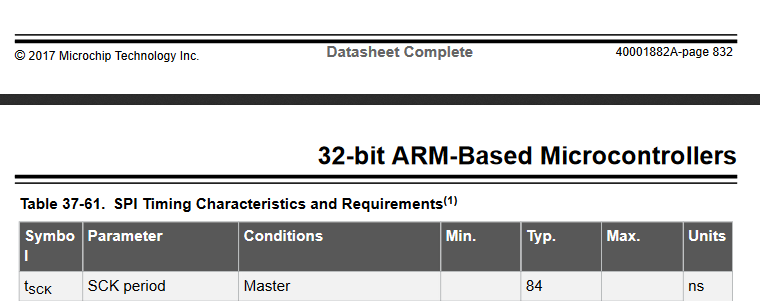
@joseangeljimenez hiya can you show us where you see tSCK of 42 ns? The one I just downloaded from microchip shows 84:
12 MHz was not chosen due to air-wiring/breadboard constraints. It was definitely the 'official' max frequency for proper SPI operation from Atmel :) I don't mind allowing 24 MHz but its not officially supported :) |
|
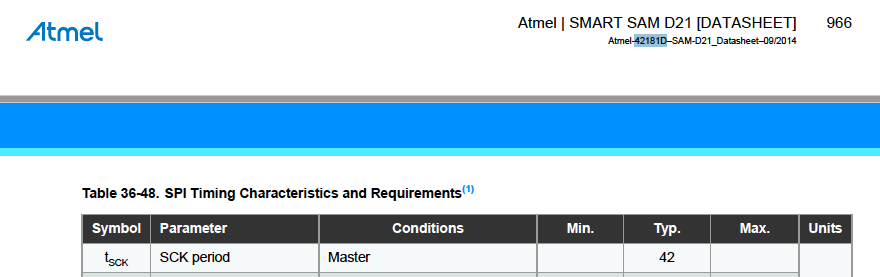
@ladyada I am really sorry for the confusion! I checked this using my old locally stored datasheet rev 42181D (dated 09/2014), where it states tSCK (typ.) = 42 ns. You are absolutely right that the newest datasheet shows 84 ns. I have been working with the SAMD21 for several years now and designed several boards using SPI clocks up to 24 MHz, with a proper layout (5-6 mils narrow, short tracks PCB). I guess that Atmel revised (conservatively) the typical value of tSCK.
|
5 participants


Fixes #464. Corrects baud rate computation to match formula. Allow baud register value to be 0, which allows maximum rate. On both M0 and M4, with SPI SERCOM clocked at 48 MHz, I can get 24Mhz SPI clock pulses now, as verified by my Saleae.
Previous error checking used to error out above a maximum SPI frequency. That was not intentional, but was due to checking for the baud register value being 0. That is no longer the case: 0 is a legitimate value. The frequency can be arbitrarily high, and you'll just get the highest available frequency from the clocked SERCOM.
I didn't add anything that returns you the actual frequency, but I could.